It’s Not Okay to Not Be Okay
We have become fluent in naming what hurts. But awareness can become another form of avoidance when it never turns into care, accountability, or action.
[reflection light cone] 8 sections
There’s a popular line floating around these days: “It’s okay to not be okay.”
It was a necessary correction.
For a long time, people were expected to hide pain, keep producing, and call silence strength. The phrase gave us permission to stop performing wellness. It made room for grief, burnout, anxiety, depression, and the simple truth that a person can be struggling without being weak or defective.
That permission matters. But permission was never meant to be the whole response.
We have become remarkably fluent in naming what is happening inside us. We can identify triggers, explain coping mechanisms, describe attachment styles, recognize burnout, and trace present reactions back to old wounds. Yet sometimes all that awareness produces no movement. We describe the pain with increasing precision while continuing to live inside the pattern that keeps causing it.
Awareness can reveal the problem. It cannot do the work of recovery for us.
That is what I mean when I say it is not okay to not be okay. I do not mean that suffering is a moral failure, or that anyone owes the world a cheerful performance. I mean that pain deserves a response, not a permanent residency.
We live in an age of hyperawareness
We are encouraged to monitor ourselves constantly: name the feeling, locate the trigger, study the pattern, learn the vocabulary, consume another explanation. Self-knowledge is valuable. A name can turn chaos into something we can finally see.
But there is a subtle trap in becoming the full-time observer of your own life. Observation feels active. Analysis feels intelligent. Talking about a pattern can feel so close to changing it that we mistake one for the other.
Knowing why I avoid a difficult conversation does not have the conversation. Calling something a coping mechanism does not make it harmless. Recognizing that I am burned out does not reduce the commitments, habits, or conditions keeping me there.
Our culture often rewards the revelation more quickly than the recovery. A public realization is visible and immediately affirmed. The slow work that follows—appointments, boundaries, repetition, repair, sleep, medication, changed routines—is quiet. It rarely gets the same attention.
So we can end up performing self-awareness while our actual lives remain untouched. We know more about ourselves than ever, but knowledge alone does not make us well.
Naming the fire is not fighting it
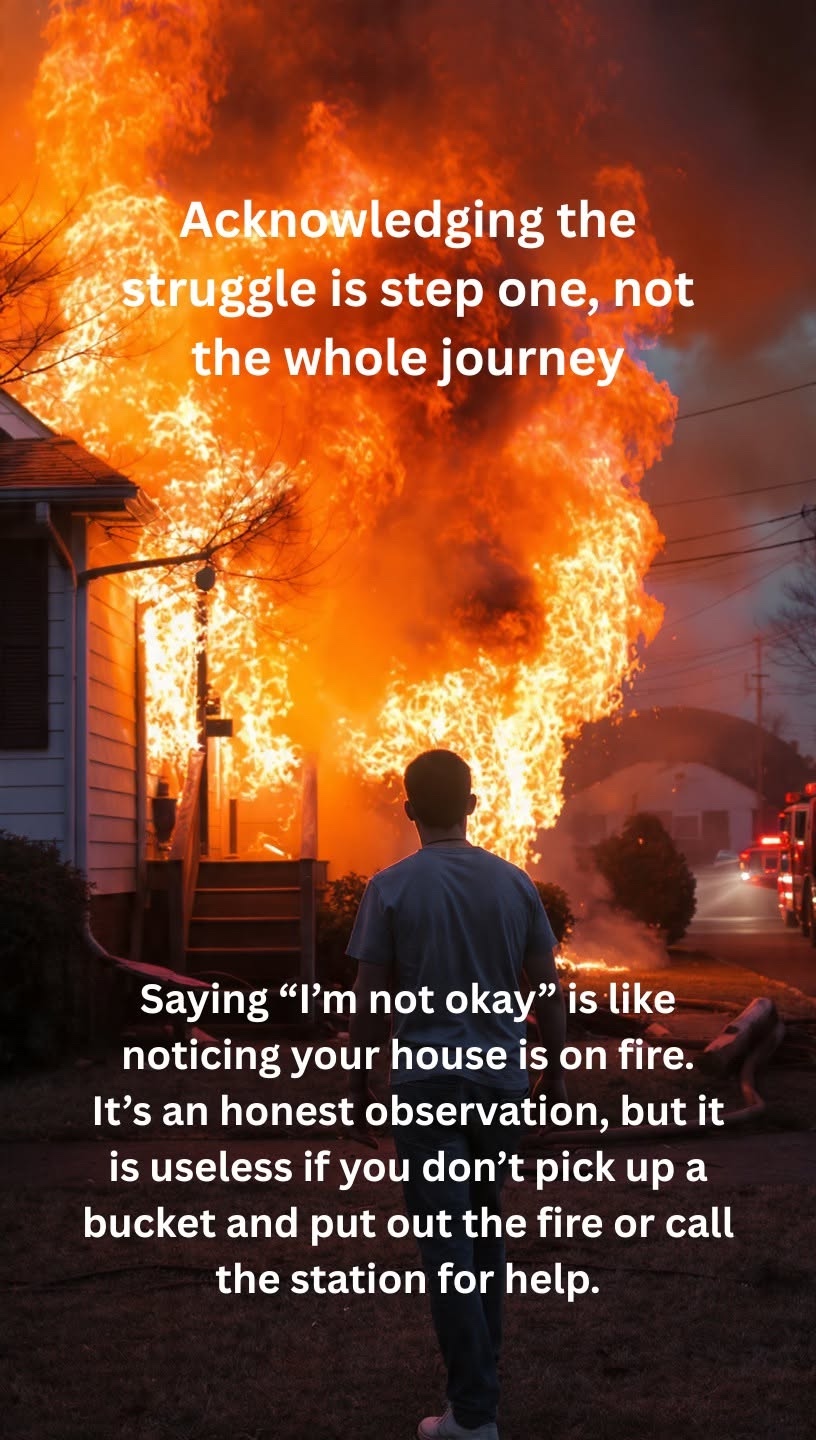
Saying “I’m not okay” is like noticing that your house is on fire. The observation is not useless. It may be the most important truth you have admitted all year. But it cannot be the final action.
Once you see the fire, something has to follow. You reach for an extinguisher. You leave the building. You call the fire station. You let someone help you out. The right response depends on the size of the fire and what you are capable of in that moment, but accurate observation does not put it out.
The same is true of emotional and mental pain. Action does not always mean forcing yourself through it alone. Sometimes action is rest. Sometimes it is changing a habit, telling the truth, calling a doctor, returning to therapy, taking prescribed medication, or asking someone you trust to stay with you.
Help is not the alternative to action. Asking for help is an action. Letting another person carry momentum you do not currently have is an action.
Strength is not measured by how long you can stand inside a burning house describing the flames.
Insight can become another form of avoidance
There is a kind of avoidance that looks almost exactly like self-improvement. We journal about the same pattern, collect language for it, listen to hours of advice, and keep waiting for one more insight to make action feel easy.
Sometimes we turn a temporary state into a permanent identity. Sometimes we use an explanation to close a conversation instead of opening one. Sometimes we call every discomfort a warning sign and every challenge to our behavior a failure of empathy.
None of the tools are the problem. Reflection, diagnosis, therapy language, rest, and boundaries can all be essential. They become avoidance when they keep us feeling engaged with the problem while protecting the routine that sustains it.
The uncomfortable question is not only “Do I understand myself?” It is “What is different because I understand this now?”
If the honest answer is “nothing yet,” that is not a reason for shame. It is a signal that awareness has reached the edge of what it can do by itself.
Compassion should not abandon agency
We needed to move away from the cruelty of “get over it.” But in correcting that cruelty, we can become so afraid of invalidating pain that we treat any invitation to act as judgment.
There is a more honest form of care: “I believe that this hurts, and I do not want this pain to become your whole life.” Those two ideas can exist together. Compassion can sit beside someone in the dark and still help them look for the door.
The same balance applies to accountability. Pain can explain why we withdraw, become defensive, demand constant reassurance, or lash out when an old wound is touched. It does not erase the impact on other people. Understanding a behavior is not the same as excusing it.
That does not make a suffering person bad. Mental illness is not a character flaw. But compassion cannot require everyone else to absorb unlimited harm, and recovery sometimes includes apology, repair, respected boundaries, and changed behavior.
A caring response is not always comfort. Sometimes it is helping make an appointment. Sometimes it is refusing to participate in a destructive pattern. Sometimes it is saying, gently and clearly, “This cannot continue as it is.”
Action is not a productivity contest
“Do something” can sound careless when a person has limited energy, money, safety, support, or access to treatment. Recovery is not a contest of willpower, and people do not begin with equal capacity.
The point is not to overhaul your life by Monday. The point is to find the next honest action that matches the capacity you actually have. On one day that may be a difficult conversation. On another it may be eating, showering, taking medication, moving an appointment instead of disappearing, or sending one message that says, “I cannot do this alone.”
Turn awareness into one workable question:
- What am I naming right now?
- What is it costing me or the people around me?
- What is the smallest action that could interrupt the pattern?
- Who can help me take it?
- When will I check whether it helped?
The step can be tiny. It can be borrowed. It can be repeated badly before it becomes steady. What matters is that awareness begins to alter reality, even by one degree.
Rest can be part of that movement. So can therapy, medication, community, leaving an unsafe environment, reducing a commitment, rebuilding a routine, or asking for practical help. Support is not the opposite of agency. Choosing support is one of the ways agency works.
Recovery is allowed to be ordinary
Hyperawareness makes every feeling feel like a revelation. Recovery is usually less dramatic. It is the appointment kept, the boundary repeated, the walk taken, the meal eaten, the apology backed by different behavior, and the unremarkable routine continued after motivation disappears.
Progress is rarely clean. A difficult week does not erase a better month. Needing help again does not mean asking the first time was pointless. There are seasons when progress means maintenance: staying safe, keeping essentials moving, and not making the wound deeper.
The question is not whether you can produce a perfect upward line. It is whether you remain in a relationship with your own recovery—whether you keep returning to care when the pattern returns.
Awareness says, “I can see what is happening.” Recovery asks, “What will I practice now that I can see it?”
“Not okay” is a condition, not a conclusion
The title is meant to be uncomfortable. “It’s not okay to not be okay” is not a verdict against people who are suffering. It is a refusal to confuse acceptance with abandonment.
Say “I’m not okay” when it is true. Say it without shame. Let the words end the performance and bring the real problem into view.
Then ask what care requires next. Take the smallest part you can take. If you cannot take it alone, ask someone to take it with you.
Awareness is the alarm. Recovery begins with what we do after we hear it.