The Fortress We Mistake for Home
A reflection on the defenses we build from old wounds, pride, and habit—and why real change begins when we stop guarding what keeps us trapped.
[reflection light cone] 5 sections
Every person has a fortress they mistake for a home.
I keep coming back to that thought because a fortress can look a lot like stability from the inside. The walls are familiar. The routines are predictable. Nothing unexpected gets through. But safety and confinement can feel almost identical when we have lived behind the same defenses for long enough.
Some bricks are easy to name: excuses, old wounds, insecurity, pride. Others look harmless because they have become ordinary. A joke that keeps a serious conversation away. Anger that arrives before honesty. Endless distraction. The sentence “that’s just who I am” repeated until a habit hardens into identity.
From the outside, the prison may be obvious. From the inside, it feels like shelter. That is why advice so often fails to reach the person who appears to need it most.
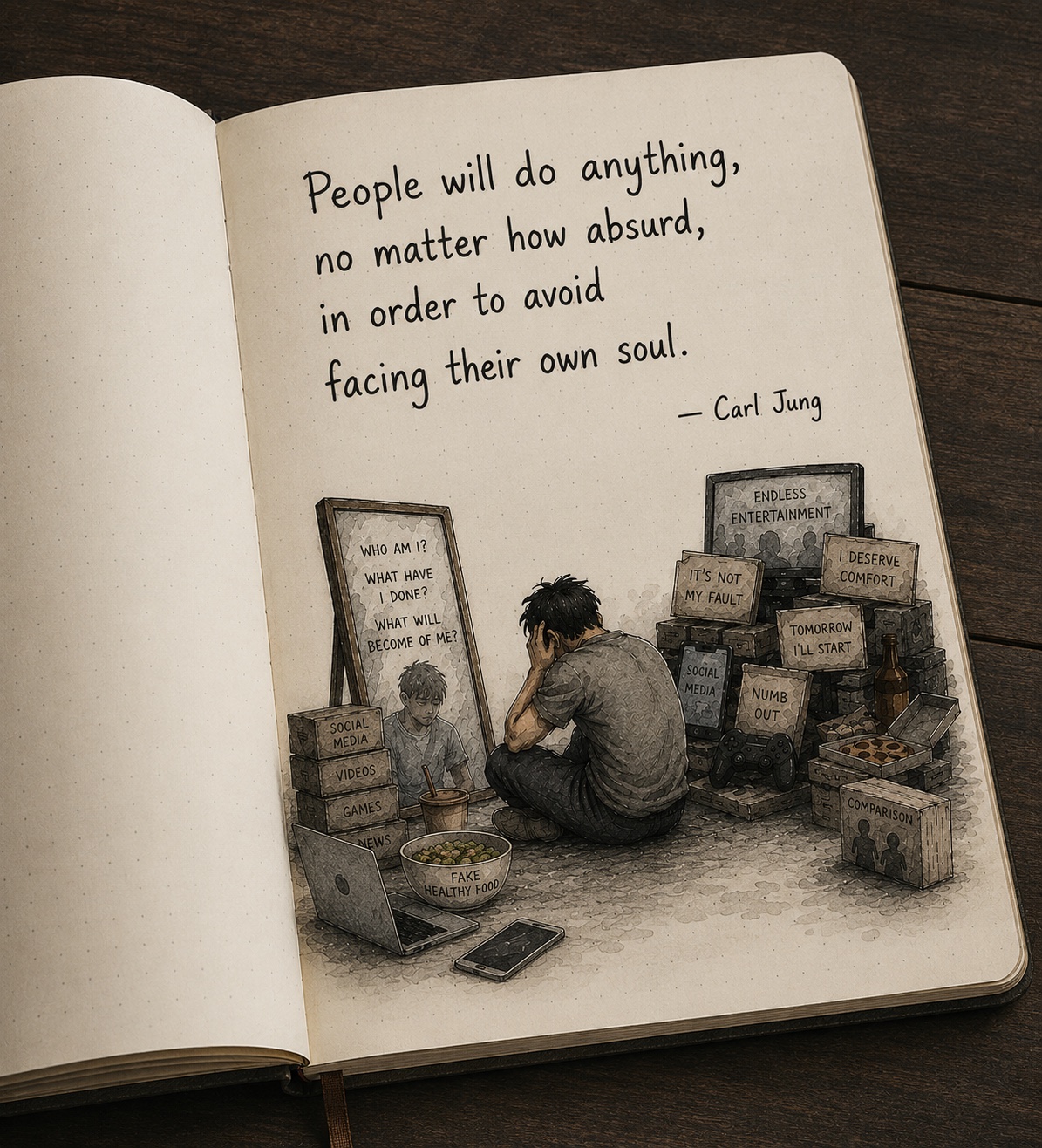
“People will do anything, no matter how absurd, in order to avoid facing their own souls.”
A defense can outlive the danger
We do not build every wall for no reason. Some defenses began as intelligent responses to something that hurt. Distance prevented another disappointment. Pride held us upright when we felt small. Control brought order to a season that felt chaotic. A person can survive because of a strategy that later keeps them from living.
The problem begins when an emergency measure becomes a permanent address. “I won’t let that happen again” quietly becomes “I won’t let anyone close.” Self-protection turns into isolation. Caution turns into suspicion. Independence becomes the refusal to receive help. Eventually the defense no longer feels like something we do. It feels like who we are.
I have to be careful not to romanticize that process. Understanding where a defense came from does not make every action acceptable. Pain can explain a reaction without excusing the damage it causes. An old wound may deserve compassion, but the people being cut by it deserve compassion too.
Why advice can sound like an attack
When identity is wrapped around survival, a suggestion to change does not sound neutral. It sounds like a demand to surrender the very thing that kept life manageable. Logic says, “This pattern is hurting you.” The ego hears, “The person you became to survive is wrong.” So the gates close.
This is why endless conversations can produce almost no movement. The missing ingredient is not always a better argument. Sometimes the person already understands the argument. What they do not yet have is the willingness to face what accepting it would require: responsibility, grief, an apology, a changed habit, or the loss of a story in which everything is somebody else’s fault.
I have learned not to confuse more pressure with more help. There are truths I can offer, doors I can point toward, and support I can give. But I cannot do another person’s inward work for them. If they are committed to defending the walls, every helping hand will look like an invading force.
Compassion also does not require standing in range of someone else’s defenses forever. I can understand why a person built the fortress and still refuse to be collateral damage inside it. Care needs boundaries or it slowly becomes permission.
Familiarity has a convincing voice
A fortress is not always dramatic. It can be made from scrolling, overworking, numbing out, comparison, resentment, or the promise that tomorrow will be different. None of those things is automatically evil. The danger is in what we ask them to help us avoid.
Familiar pain often feels safer than unfamiliar possibility. At least I know the rules of the pattern I already live in. Change removes those rules. It asks me to step into a life where I cannot use the same excuses, predict every disappointment, or keep assigning the same roles to myself and everyone around me. Even a better future can feel threatening when it has no familiar floor.
That is the ego’s cleverest defense: it does not announce, “I want to remain trapped.” It says, “I am being realistic.” It calls fear wisdom, avoidance peace, and repetition personality. It makes the locked room feel mature and the open door feel reckless.
The harder mirror
It is easy for me to write about other people’s fortresses. I can see their patterns because I do not have to feel their fear. The real test is noticing my own walls before I turn this reflection into another way of judging somebody else.
That means pausing when I hear myself reach for familiar defenses:
- “That’s just how I am.”
- “They made me react this way.”
- “I’ll deal with it when things calm down.”
- “Nobody understands what I’ve been through.”
- “I deserve comfort, so this cannot be a problem.”
Those sentences may contain part of the truth. That is exactly why they are convincing. But a partial truth can still hide a larger one. The useful questions are more uncomfortable: What reaction keeps repeating in my life? What do I blame on other people that is still mine to manage? What am I protecting, and what is that protection costing me now?
Facing myself does not mean hating myself. Shame is just another wall if it leaves me frozen. Honest self-reflection is more demanding and more humane: I can acknowledge why I became this way, admit the impact, and accept that changing it is now my responsibility.
The gate opens from the inside
No conversation, book, opportunity, or act of love can force that gate open. They can create a moment of recognition, but change begins only when a person stops treating every challenge to the defense as a threat. The decisive moment is quiet: “This protected me once, but it is hurting me now.”
From there, change can be ordinary:
- Tell the truth before polishing the excuse.
- Apologize without explaining away the impact.
- Sit with discomfort instead of immediately numbing it.
- Ask for help before pride turns struggle into isolation.
- Replace one familiar reaction with one deliberate response.
None of this looks heroic. Most real change does not. It is repetitive, private, and often invisible to everyone except the people who no longer have to absorb the old pattern. The wall comes down one honest act at a time.
Some people will not choose that work yet. I cannot choose it for them. What I can do is stop rewarding the defense, keep my boundaries clear, and make sure I am not building the same kind of fortress while pointing at theirs.
What we refuse to confront within ourselves does not disappear. It works from the shadows, shaping our choices, our relationships, and the life we call normal.
A home has doors. It lets truth enter. It makes room for repair. A fortress assumes every knock is an attack. The hardest freedom is realizing when the walls protecting us have become the walls keeping us in—and then choosing to open the gate.