How I Use MemPalace to Make Local Agents Better
How I set up MemPalace as a practical tool for local agents: small taxonomy, verify-first retrieval, agent diaries, AAAK wake-up context, and why protocol matters more than storage.
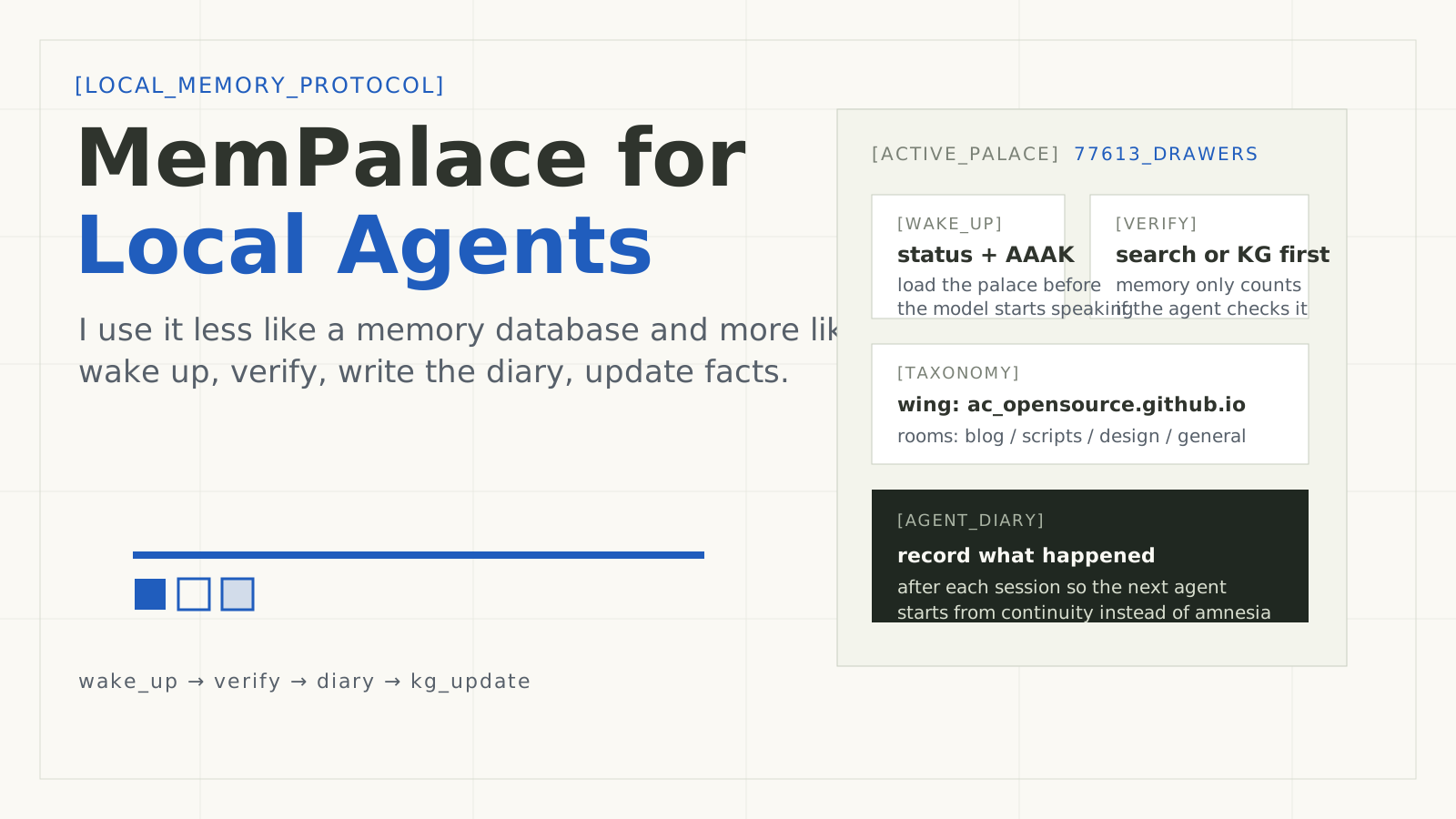
[systems debrief] 8 sections
I do not think of MemPalace as a clever memory benchmark or a library feature. I use it as a tool in the loop between me and my local agents. That distinction matters. A memory system is only useful if it changes behavior at the moment an agent is about to answer, summarize, or make a decision.
The part that changed my workflow was not “the model remembers more.” It was that I finally had a repeatable protocol for waking an agent up, giving it context, forcing it to verify before speaking, and recording what happened after the session. The collection changes as I mine new project and conversation material. The raw drawer count is not the point. The point is that the next agent no longer starts from zero.
01. I Use It as a Tool, Not a Theory
There are two easy ways to misuse memory systems. The first is to treat them like magic and expect the model to suddenly become wise. The second is to treat them like passive storage and assume retrieval will happen on its own. Both fail.
What works for me is much simpler: MemPalace sits beside the agent as working memory infrastructure. It is local, searchable, model-agnostic, and explicit about when the agent should consult it. I have also contributed a bit back to the open-source project, so I care about it both as a user and as someone who wants the tool to stay honest about what it actually does well.
The thing I value most is not the headline recall number. It is that it turns memory into operational discipline. That is what makes local agents noticeably better.
02. My Setup Is Intentionally Small
I am not trying to model my whole life in one giant ontology. I use a small amount of structure that is stable enough for repeated work. On this site, for example, I keep a repo-level MemPalace config with a single wing and four practical rooms: blog, scripts, design, and general.
wing: ac_opensource.github.io
rooms:
- name: blog
  description: Files from blog/
- name: scripts
  description: Files from scripts/
- name: design
  description: Files from assets/
- name: general
  description: Files that don't fit other rooms
That is enough for a local agent to stop treating the repo as an undifferentiated pile of files. It can narrow its search space, distinguish content from build logic, and recognize when a request probably belongs to UI assets versus article content.
My setup pattern is basically this:
mempalace init ~/PersonalProjects/ac-opensource.github.io
mempalace mine ~/PersonalProjects/ac-opensource.github.io
mempalace mine ~/chats --mode convos
I mine project material and conversation material separately, but I want both available to the same agents. One gives them the code and docs. The other gives them the reasoning, tradeoffs, and dead ends that usually disappear once a session ends.
03. The Protocol Matters More Than the Storage
The single best thing in MemPalace is not a storage format. It is the protocol attached to the tool.
Storage is not memory. Storage plus a protocol is memory.
The version I use is straightforward:
- Wake-up: load palace status and the AAAK dialect before the session really starts.
- Verify: before answering about a person, project, or earlier decision, query the palace or the knowledge graph first.
- Write the diary: after the session, log what happened, what changed, and what matters.
- Update facts: when something changes, invalidate the old fact and add the new one instead of letting drift accumulate.
That sounds almost boring, which is exactly why it works. A local agent improves when it has fewer chances to improvise fake continuity. I would rather have a model say “let me check” and hit the palace than confidently stitch together an answer from half-remembered context.
04. Why It Helps Local Agents More Than Hosted Ones
Strong models can mask bad memory discipline by producing plausible answers from incomplete context. Smaller local models make the weakness easier to notice, but the failure belongs to the workflow in both cases: retrieval must be deliberate, and remembered context must still be verified.
That is why MemPalace fits my local workflow so well. It gives local agents four things they usually lack:
- Durability: the session can end without losing the trail of why something was done.
- Scoped recall: wing and room filters reduce broad, sloppy retrieval.
- Model portability: the memory sits outside the model, so switching agents does not erase continuity.
- Post-session reflection: diary entries turn one-off work into cumulative behavior.
In practice, this means a local agent can come in cold, read the wake-up context, search verbatim drawers, and start operating like it has history. Not human history. Not magical history. Just enough grounded continuity to avoid repeating mistakes.
05. AAAK Is Useful Because It Is Still Readable
I like AAAK for one specific reason: it is compressed without becoming opaque. I do not need a custom binary decoder or a model-specific plugin. It stays text-shaped. The agent can read it, I can read it, and the compression layer still looks like a memory artifact rather than a black box.
I do not use it as an excuse to stop keeping the original words. Verbatim drawers still matter. But AAAK is good at making the wake-up layer and the diary layer lighter, tighter, and easier for agents to carry from session to session.
That balance matters to me. If memory becomes unreadable, I stop trusting it. If it stays human-legible, I can inspect the system when the agent starts behaving strangely.
06. The Agent Diary Changed My Expectations
The diary feature looks small on paper, but it is the part that most changed how I work. Each agent gets its own wing and diary room. That means I can treat an agent less like a disposable prompt executor and more like an operator with a trail of observations.
After a session, I want the next run to inherit answers to questions like these:
- What did we touch?
- What did we learn?
- What uncertainty still exists?
- What should the next agent check before doing anything new?
Without that, every local agent behaves like a talented amnesiac. With it, the agent starts accumulating judgment. Not perfect judgment. But enough to avoid relitigating the same context on every run.
07. What I Would Not Do
I would not let any memory system become a silent source of truth. Memory tools drift. Facts expire. Bad entries compound if the agent is allowed to write loose claims without later verification.
So my rule is simple: search is retrieval, knowledge graph is assertion, diary is perspective. Those are different layers. Mixing them carelessly is how memory becomes noise.
I also keep the taxonomy intentionally restrained. If you create too many rooms too early, the palace becomes decorative instead of useful. The best structure is the one the agent can reliably reuse under pressure.
08. Why I Keep Using It
I keep using MemPalace because it makes local agents feel less disposable. The gain is not that the model suddenly knows everything. The gain is that the system starts preserving continuity across real work: architecture discussions, content edits, debugging sessions, and the small judgments that usually vanish between runs.
That is the threshold I care about now. Not “does the agent sound smart?” but “does the next session start from somewhere real?”
MemPalace gets me closer to that than any sticky-note memory feature I have used. It gives me a local, inspectable, model-agnostic way to make agents a little more careful, a little less repetitive, and a lot less forgetful.