Career Growth as Ownership, Not Just Job Titles
A practical framework for reading engineering growth through scope, decision quality, operational responsibility, and durable outcomes.
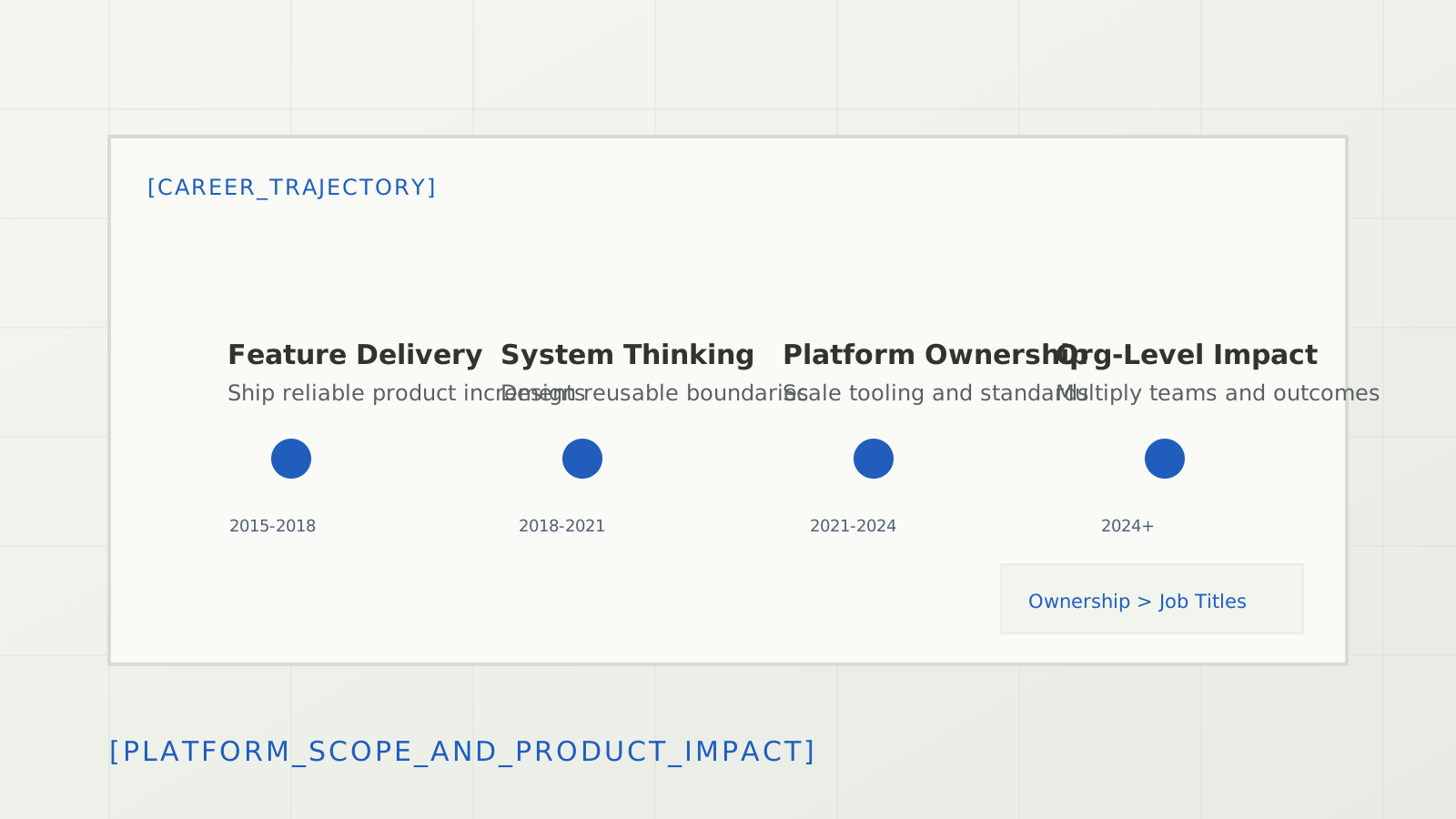
[systems debrief] 4 sections
Job titles are useful shorthand, but they are a lossy way to describe engineering growth. The same title can mean maintaining one feature in one company and owning a critical product surface in another. The better question is not only, “What were you called?” It is, “What could people trust you to carry from ambiguity to production?”
I use ownership depth as one lens for answering that question. It is not a universal ladder and it does not make platform work more valuable than specialist work. It simply makes the evidence of growth easier to discuss: decisions made, boundaries understood, failures handled, and useful systems left behind.
01. Four useful ownership scopes
- Task ownership: complete a scoped change reliably, follow the surrounding conventions, and surface uncertainty before it becomes rework.
- Feature ownership: carry a user flow across UI, data, failure states, verification, rollout, and the awkward integration points between them.
- System ownership: understand how several features share state, APIs, observability, release constraints, and operational risk.
- Platform ownership: create a reusable capability or operating pattern that helps several products or teams move with fewer repeated mistakes.
These scopes overlap. A senior engineer still needs to handle small tasks well, and a narrowly focused specialist can have enormous system impact. Growth is visible when the engineer can move between scopes deliberately instead of treating every problem as an excuse for a larger abstraction.
02. Evidence is better than title inflation
Ownership becomes credible through evidence. Did the engineer clarify an ambiguous contract before implementation? Could they trace a production failure across client, service, and stored state? Did the release include a rollback path? Did a pattern they introduced reduce repeated work, or did it merely add another layer?
Questions I use to assess growth:
- What decisions became clearer because this person was involved?
- Which failure modes did they make easier to detect or recover from?
- Can someone else maintain the result without inheriting hidden context?
- Did they improve the path to delivery, not only the code produced on that path?
- What did they choose not to build, and why?
03. Ownership includes maintenance and restraint
The glamorous version of ownership is starting something. The durable version includes operating it after launch, responding when assumptions fail, and simplifying it when the original design becomes too expensive. It also includes saying no to changes that create more surface area than value.
A platform is not mature because it has many consumers or an impressive diagram. It is mature when its contract is clear, its failure modes are visible, and its maintainers can change it without coordinating a small emergency. Sometimes the best platform decision is to keep a solution local until a second real use case proves that sharing is worthwhile.
04. AI changes the economics, not the accountability
Agentic tools have made implementation and exploration faster. That makes ownership more important, not less. When it is cheap to generate several plausible solutions, the scarce work is deciding which one belongs in the product, proving that it integrates with the real system, and preserving enough evidence for someone else to review it.
I do not read career growth as a race away from coding. I read it as a widening ability to connect code with product intent, operational reality, and team continuity. Titles may eventually reflect that. The ownership usually appears first.